Portuguese
 English
 German
 Spanish
 Turkish
 French
 Arabic
 Korean
 Italian

A drill tap center is generally better suited to repetitive drilling, tapping, and light milling, while a centro de maquinagem vertical (VMC) offers greater flexibility for a wider range of machining operations. The right choice depends on workpiece geometry, machining requirements, production volume, and machine configuration.


1. What Is the Difference Between a Drill Tap Center and a VMC?
Both machines can perform drilling, tapping, and milling, but their design priorities differ.
A drill tap center focuses on high-speed hole-making operations. It is suitable for parts requiring repeated drilling and tapping, frequent tool changes, and quick positioning.
A VMC is designed for general-purpose machining. Depending on its configuration, it can handle drilling and tapping as well as milling, boring, and pocket machining.
| Feature | Drill Tap Center | VMC |
|---|---|---|
| Main focus | Drilling and tapping | General machining |
| Milling capability | Configuration-dependent | Broader operations |
| Work envelope | Often compact | Various sizes available |
| Production focus | Repetitive hole-making | Mixed machining tasks |
The two machine types are not completely separate. Drill tap centers can perform milling, while VMCs can also handle drilling and tapping. Buyers should compare actual machine specifications rather than assume either machine is limited to one type of operation.
2. Which Machine Is Better for Your Workpiece and Machining Operations?
The actual machining requirements of a workpiece are more important than its industry or product category.
Drill Tap Center: Repetitive Drilling and Tapping
Consider a drill tap center when:
- The workpiece contains many repeated holes and threaded features.
- Drilling and tapping account for most of the machining cycle.
- Parts are relatively compact and use stable fixtures.
- Milling is required but is not the main operation.
For example, a plate-like component with multiple drilled and tapped holes may benefit from rapid positioning and tool changes.
GONGTIE's T Series is designed for precision drilling and milling, with applications including 3C industrial parts, new-energy vehicle components, and precision mold processing.
Explore the GONGTIE T Series Drill Tap Center.
VMC: A Wider Range of Machining Operations
A VMC may be more suitable when:
- The workpiece requires substantial milling in addition to drilling and tapping.
- Deep pockets, contours, or multiple machining features are involved.
- Larger tools or higher cutting loads are required.
- The workpiece or fixture needs a larger machining envelope.
For example, a housing requiring pocket milling, face machining, drilling, and tapping may benefit from the broader capabilities of a VMC.
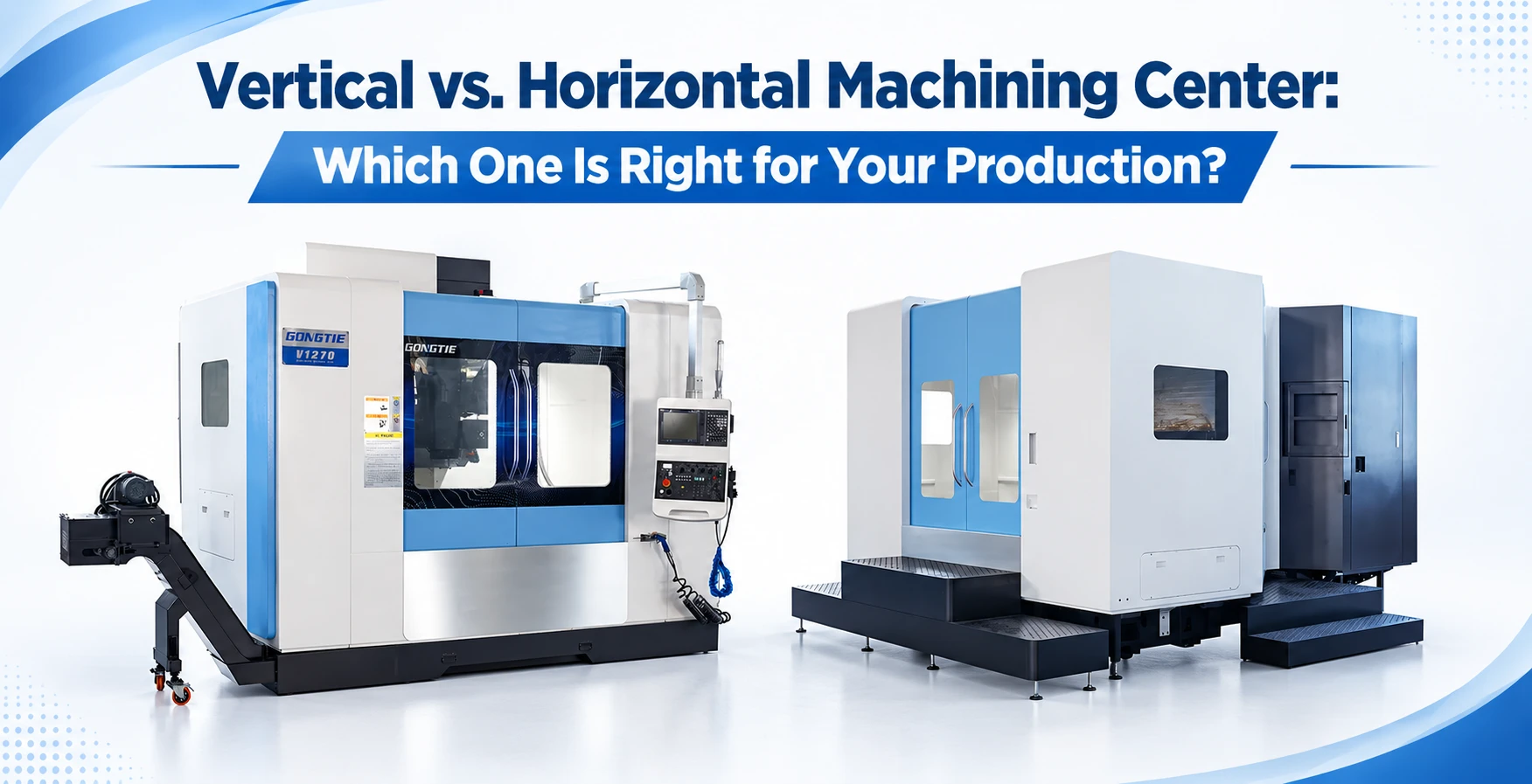
GONGTIE's V/VM Series supports milling, boring, drilling, and tapping in one clamping, targeting small and medium-sized mechanical parts.
Explore the GONGTIE V/VM Series Vertical Machining Centers.
Before choosing, consider the main machining operations, hole quantity, milling requirements, and space needed for the workpiece and fixture.
3. Key Specifications to Compare When Choosing Between a Drill Tap Center and a VMC
Four groups of specifications deserve attention when comparing machine models.
Worktable Size and Axis Travel
The worktable must accommodate both the workpiece and fixture. X, Y, and Z-axis travel must cover all machining positions. For taller workpieces or longer tools, Z-axis travel and spindle-to-table distance are particularly important.
For example:
| Especificação | T800 | V855 |
|---|---|---|
| Worktable | 1,000 × 500 mm | 1,000 × 500 mm |
| X-axis travel | 800 mm | 800 mm |
| Y-axis travel | 500 mm | 500 mm |
| Z-axis travel | 330 mm | 550 mm |
Although both models have the same worktable dimensions and X/Y travel, their Z-axis travel differs. This matters when evaluating workpiece height, fixture height, and tool clearance.
Spindle Speed, Power, and Torque
Maximum spindle speed alone cannot determine machining capability. Drilling and tapping require suitable speed ranges and controlled spindle reversal, while milling also depends on power, torque, tool diameter, material, and cutting depth.
Buyers should request spindle power and torque curves for the specific machine configuration.
Machine Structure and Rigidity
The bed, column, guideways, spindle support, and overall structure affect machining stability. Tool diameter, cutting depth, material, and tool overhang also influence cutting loads.
Neither machine type should automatically be considered more rigid. Compare actual specifications and request machining tests when necessary.
Rapid Traverse and Tool Changing
Rapid traverse affects movement time between machining positions, while tool-changing performance matters when multiple drills, taps, and milling cutters are used.
GONGTIE lists the following rapid traverse specifications:
- T800: 48/48/48 m/min (X/Y/Z).
- V855: 36/36/24 m/min (X/Y/Z).
These figures represent rapid movement speeds, not cutting feed rates or guaranteed cycle times. Actual production time also depends on movement distance, acceleration, tool changes, and the machining program.
4. Which Machine Offers Better Productivity and Cost Efficiency?
Productivity depends on how closely machine capabilities match the actual machining process.
| Production Factor | Drill Tap Center | VMC |
|---|---|---|
| Repetitive hole-making | Often a strong fit | Can perform the work |
| Mixed milling | Configuration-dependent | Generally more flexible |
| Setup requirements | Stable fixtures support repeat production | Accommodates varied jobs |
| Production flexibility | Consistent hole-making | Changing machining tasks |
A drill tap center may reduce cycle time when production involves repeated hole-making and frequent tool changes. A VMC may offer better value when several machining operations can be completed in one setup.
Before comparing costs, consider machine price, tooling and fixtures, setup time, machining cycle time, operator handling, and production volume.
For repeat production, compare the estimated cost per part using the same workpiece, tooling assumptions, and production quantity. A higher spindle speed or lower purchase price does not automatically mean a lower cost per part.
5. How to Choose Between a Drill Tap Center and a VMC?
Use the main production requirements to narrow down the options.
| Production Requirement | Machine to Evaluate |
|---|---|
| Repeated drilling and tapping | Drill Tap Center |
| Drilling, tapping, and light milling | Drill Tap Center |
| Extensive pocket milling and contour machining | VMC |
| Larger workpiece or fixture | Suitable VMC |
| Frequently changing operations | VMC |
| Drilling, tapping, and demanding milling | Compare actual configurations |
GONGTIE's T Series includes T700, T800, T1000, and T1300 drill tap centers. Its V/VM Series includes V855, V966, V1167, V1270, VM1380, and VM1580 vertical machining centers.
Tool magazine capacity depends on the selected configuration. The T Series lists a 21-tool magazine as optional, while V/VM Series options vary by model. Confirm the actual configuration when requesting a quotation.
Before contacting a supplier, prepare:
- Workpiece drawings, dimensions, and material.
- Hole quantity, diameter, depth, and thread specifications.
- Milling operations and cutting requirements.
- Fixture dimensions and workpiece weight.
- Production volume, required tolerances, and target cycle time.
Conclusão
Choose a drill tap center when repetitive hole-making is the main production task. Consider a VMC when broader milling capabilities and machining flexibility are more important.
Need help selecting a suitable machine? Contact GONGTIE with your workpiece drawings, material, and machining requirements. Its team can help evaluate the appropriate model and configuration for your production needs.